

General Instructions
A compass can be used for a variety of purposes, from determining which way is north to discovering hidden treasure or following an unmarked path through wilderness terrain. But you have to start small, so let's look at how the a compass is laid out.
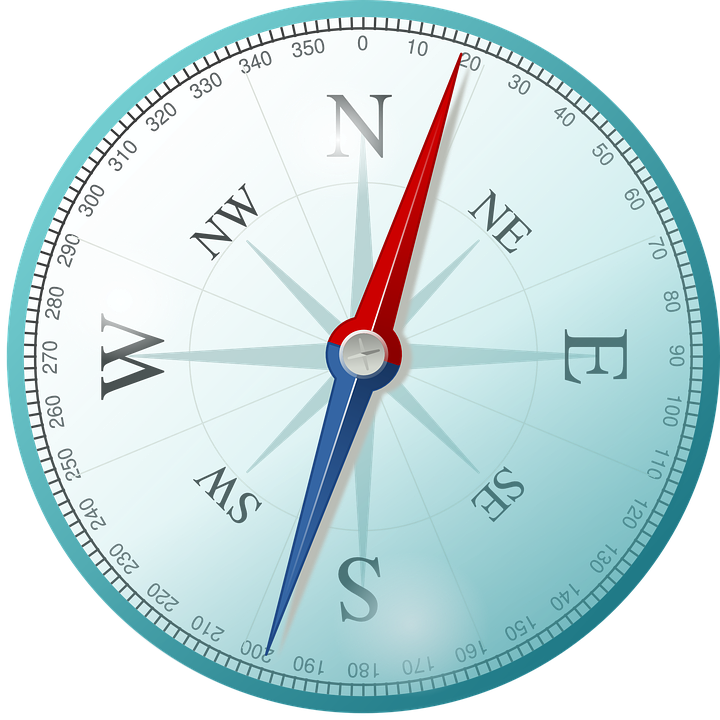
A compass has four cardinal points: north, south, east, and west. When reading a compass and giving directions to others, you should eliminate the words "right" and "left" from your vocabulary. Right and left are relative directions that change depending on where you are and which way you are facing, but the cardinal points remain constant.

Northeast refers to the direction halfway between North and East, which is an intercardinal point. South-east, South-west, and Northwest are the other three intercardinal points.
Finally, secondary intercardinal points are located halfway between each cardinal and intercardinal point. North-NorthEast, East-Northeast, East-Southeast, South-Southeast, and so on. With these instructions, you can give someone a good idea of where they need to go. We could add more points by dividing each section in half again and again, but telling someone to go East-EastEastNorth would be boring.

Compass Reading Fundamentals
One end of the needle always points north, regardless of the compass. It is almost always the RED end on our mountaineering compasses, but it is a good idea to test your compass before using it.
If you are north of the equator, face the sun around lunchtime and hold your compass in front of you. The end of the needle pointing towards the sun is South, and the end pointing towards you is North.
When you're 'down under,' the north end points to the sun, and the south end points to you.
In order to read your compass,
- Keep your compass steady in your hand, with the baseplate level and the direction-of-travel arrow pointing straight away from you.
- Hold it in a comfortable arm position, halfway between your face and waist, with your elbow bent and the compass close to your belly.
- Examine the compass to see where the needle points.
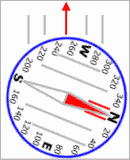
The needle on this compass is pointing north (also 0 degrees).
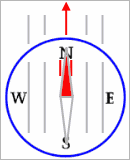
- Keep the compass in front of you as you turn your body.
- The needle on the compass remains pointing in the same direction as the compass rotates.
- Continue turning until the needle on the compass points to the East, as shown in the image below, while keeping the direction-of-travel arrow and North mark straight in front of you.
This compass's needle is pointing East (90 degrees).
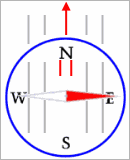
Important: This is a common blunder! Because the compass needle is pointing East, I must be pointing East, right? No way, no how!
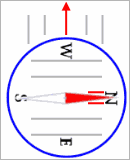
To determine my bearing, I must turn the compass dial until the North mark and the "Orienting Arrow" align with the North end of the needle. Then I can read the heading at the Index Pointer location (the butt of the direction-of-travel arrow).
Because the Orienting Arrow is typically two parallel lines on the floor of the compass housing, it's a good idea to remember:
THE COLOR RED IN THE SHED
We now know we're heading West (270 degrees)
Take a Position
You can get a good idea of which way you're going by simply moving your compass with your body and using the N-E-S-W markings. This is frequently all you require from your compass. But, as you've probably noticed, there are also numbers and tiny lines on your compass. These represent the 360 degrees in a circle that surround you regardless of where you are.
Here are some videos that demonstrate how to use the compass:
Comments
Post a Comment